Sakana AI bets AI that improves itself can break the compute arms race of frontier labs
"Sakana AI bets on recursive self-improvement to break compute arms race, posing risks and opportunities."
Sakana AI, a Japanese startup, has launched a research lab in Tokyo, focused on recursive self-improvement. Founded in 2023 by former Google researchers, including Llion Jones and David Ha, Sakana AI aims to develop AI systems that can iteratively redesign and improve themselves, creating a compounding cycle of progress.
The Sakana AI RSI Lab builds on the company's earlier work on evolutionary, adaptive AI systems and practical steps toward recursive self-improvement. The lab's launch is a significant development in the field of AI research, as it has the potential to break the compute arms race that currently dominates the industry. Sakana AI's approach focuses on developing AI systems that can improve themselves without relying on massive amounts of computational power.
According to Sakana AI, recursive self-improvement is no longer purely theoretical, but is already being tested in controlled research environments. The company points to several research milestones from the past two years, including LLM-Squared, where language models design better training methods for other language models, and the Darwin Gödel Machine, which generates, tests, and iterates on variants of its own codebase. These projects demonstrate the potential of recursive self-improvement to accelerate the development of new AI systems.
Sakana AI's roadmap for recursive self-improvement consists of four phases. The first phase involves developing models designed for open-ended agent tasks from the ground up. The second phase involves applying agent capabilities to automated research, from idea generation and experiments to writing scientific papers. The third phase involves recursive self-improvement itself, where AI agents actively work on their own technical foundations by writing, benchmarking, and verifying code for their underlying architectures. The fourth phase and long-term goal is broader access to frontier AI.
The launch of the RSI Lab puts a spotlight on an issue that Anthropic recently flagged as a potential safety concern. Anthropic shares Sakana AI's view that recursive self-improvement could lead to more efficient and widely accessible frontier AI, but also warns about the risks. Full recursive self-improvement hasn't been achieved yet, but once it is, AI systems could drive their own development faster than institutions can keep up. For that scenario, Anthropic has floated the idea of a global pause on frontier AI development as something worth considering.
Sakana AI's approach to recursive self-improvement is distinct from the dominant scaling paradigm, which relies on training ever-larger monolithic models with ever more compute. Instead, the company bets on adaptive systems and evolutionary optimization, where AI finds better solutions in as few attempts as possible. This approach has the potential to work with moderate compute and depend less on the massive GPU clusters that big US AI labs and cloud providers run today.
The implications of Sakana AI's research are significant. If successful, recursive self-improvement could lead to a new era of AI development, where systems can improve themselves without relying on human intervention. This could lead to breakthroughs in fields such as medicine, finance, and education, where AI can be used to analyze complex data and make predictions. However, it also poses significant risks, including the potential for AI systems to become uncontrollable and cause harm.
As the field of AI research continues to evolve, it is likely that we will see more companies and researchers exploring the potential of recursive self-improvement. Sakana AI's launch of the RSI Lab is a significant development in this area, and it will be interesting to see how their research progresses in the coming years. One thing is certain, however: the potential of recursive self-improvement to break the compute arms race and lead to more efficient and widely accessible frontier AI is an exciting and potentially game-changing development in the field of AI research.
In the context of the current AI landscape, Sakana AI's approach is a breath of fresh air. While many companies are focused on scaling up individual large models, Sakana AI is taking a more nuanced approach, focusing on evolutionary, adaptive, and multi-part AI systems. This approach has the potential to lead to more robust and generalizable AI systems, which can be applied to a wide range of tasks and domains.
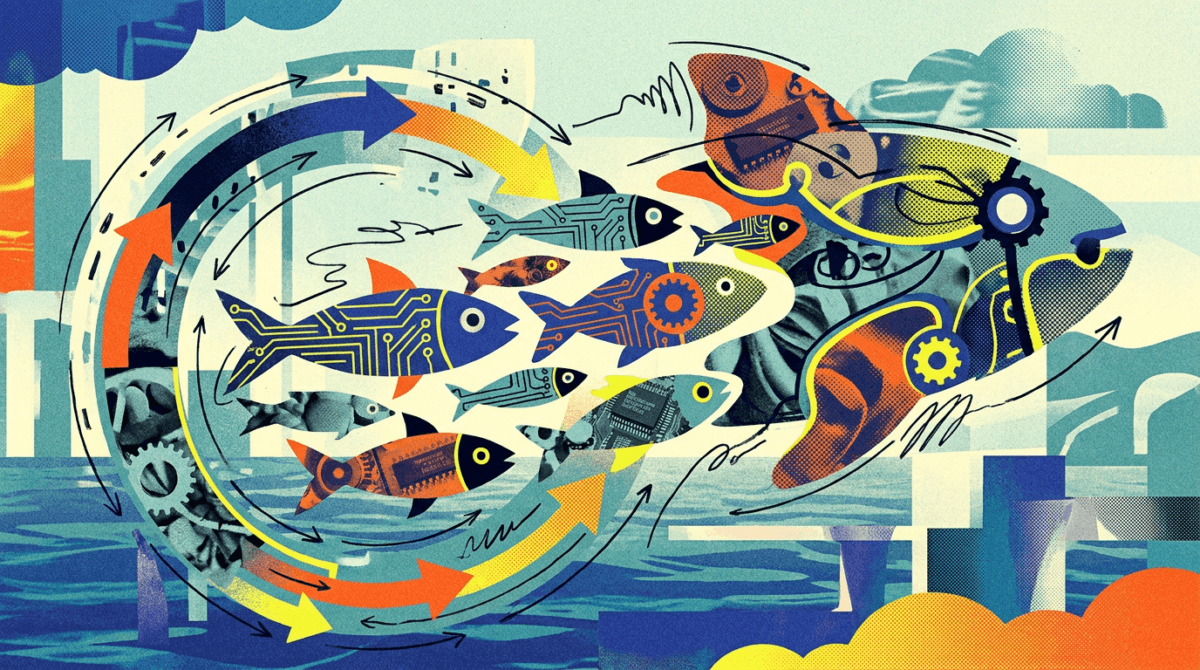
The name "Sakana" means "fish" in Japanese, a nod to swarm behavior, evolution, and collective intelligence. This name reflects the company's focus on developing AI systems that can learn and adapt in a collective and evolutionary manner. As the company continues to push the boundaries of AI research, it will be interesting to see how their approach evolves and whether they can achieve their goal of breaking the compute arms race.
In conclusion, Sakana AI's launch of the RSI Lab is a significant development in the field of AI research. The company's approach to recursive self-improvement has the potential to lead to breakthroughs in a wide range of fields, from medicine to finance to education. However, it also poses significant risks, including the potential for AI systems to become uncontrollable and cause harm. As the field of AI research continues to evolve, it is likely that we will see more companies and researchers exploring the potential of recursive self-improvement, and it will be interesting to see how Sakana AI's research progresses in the coming years.