MIT researchers have developed a long-term memory framework for robots
"Robots may soon recall complex environments, aiding human workers."
MIT researchers have developed a long-term memory framework for robots. They created a method that allows robots to rapidly form and recall detailed mental models of complicated environments. This advance could enable factory workers to send robotic assistants to fetch items, simply by asking them to retrieve a component started the previous night.
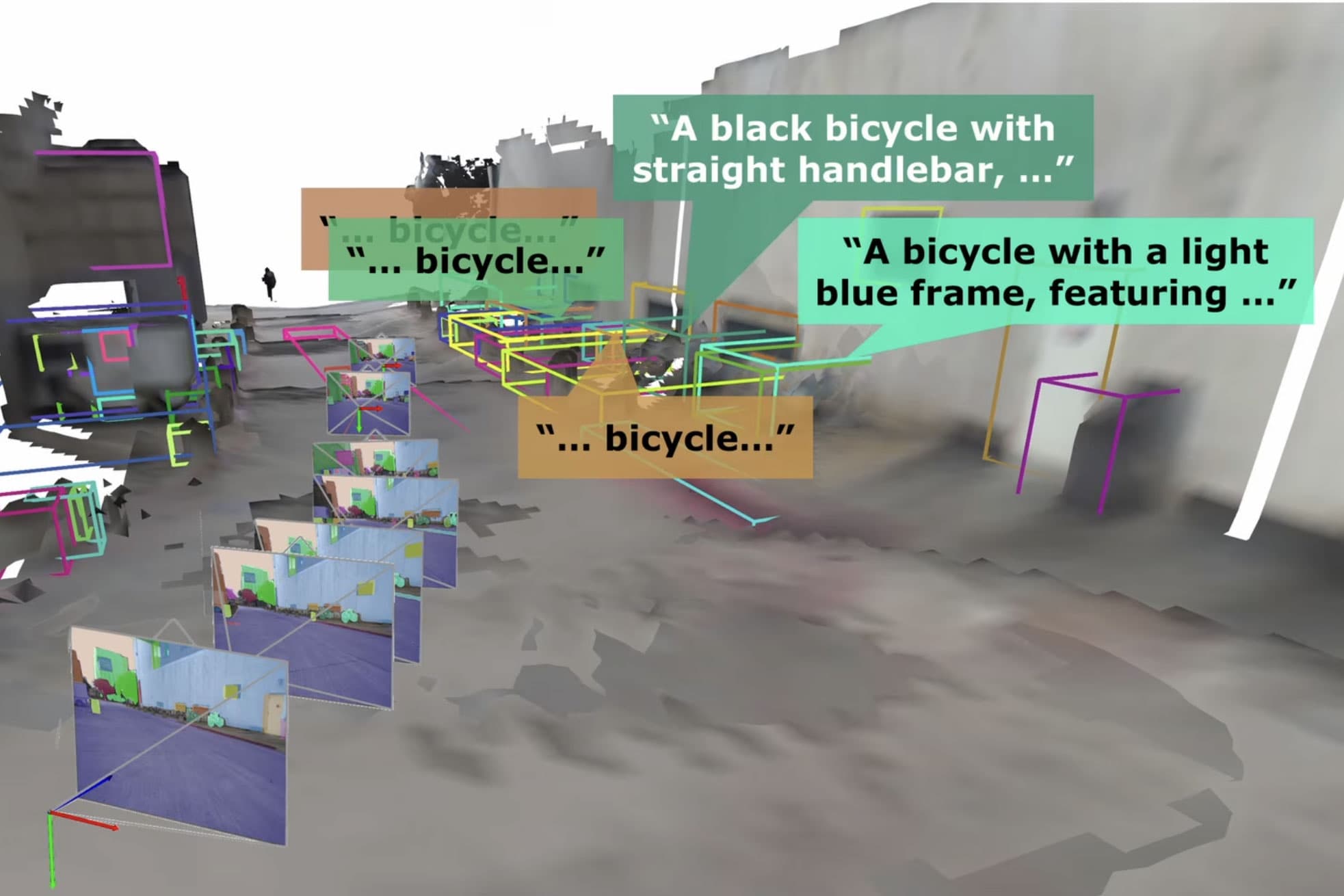
The new method, called Describe Anything, Anywhere, Anytime, at Any Moment (DAAAM), combines advanced map representations with rich descriptions of the environment that the robot gathers over time. According to Luca Carlone, an associate professor in MIT's Department of Aeronautics and Astronautics, this memory framework turns a traditional map into a language-based map that is easier for the robot to think about and access using language.
The researchers bridged two lines of work: computer vision and robotic mapping. Multimodal computer vision models can understand and richly describe objects in a scene, but they often only process a single annotation at a time. On the other hand, robotic mapping frameworks create 3D maps of an environment, but usually lack detailed descriptions of objects or are computationally expensive. DAAAM takes the best of both approaches, attaching rich descriptions to objects as a robot traverses its environment.
For instance, a robot may note that a particular building on the MIT campus is called the Stata Center and is designed with a certain type of architecture, or that a bike rack holds five bikes. This information can be quickly accessed to answer complex queries about the environment in plain language. The memory framework runs fast enough for a mobile robot to use in real-time, making it a significant advance in robotics.
The implications of this research are far-reaching. If robots can develop and access spatiotemporal memory, they can work more effectively alongside humans. Factory workers can send robotic assistants to fetch items, and maintenance workers can use augmented reality systems to detect anomalies. Commuters can use these systems to navigate complex environments. According to Carlone, the goal is to enable robots to reason about time and space the same way humans do, essentially turning a traditional map into a language-based map.
The research was recently presented at the Conference on Computer Vision and Pattern Recognition (CVPR). The team, which includes lead author Nicolas Gorlo, an MIT graduate student, and Lukas Schmid, a former research scientist at MIT, now a professor at the University of Technology Nuremberg in Germany, is working to further develop the DAAAM method. They plan to apply it to various scenarios, including robotics, augmented reality, and other areas where spatiotemporal memory can be useful.
In addition to its potential uses in robotics and augmented reality, the DAAAM method could have applications in other fields. For example, it could be used in autonomous vehicles to enable them to navigate complex environments and recall specific locations. It could also be used in smart homes to enable robots to recall the location of specific objects and navigate around them.
The development of spatiotemporal memory is a significant step forward in artificial intelligence. It enables robots to reason about time and space, essentially giving them a sense of memory and recall. This can be used in various scenarios, from robotics and augmented reality to autonomous vehicles and smart homes. As the researchers continue to develop and refine the DAAAM method, we can expect to see significant advances in these fields.
The potential benefits of this research are substantial. If robots can develop and access spatiotemporal memory, they can work more effectively alongside humans, improving productivity and efficiency. They can also be used in various scenarios, from factory work to maintenance and commuting, making our lives easier and more convenient. As the researchers continue to work on this project, we can expect to see significant advances in robotics, artificial intelligence, and related fields.
In conclusion, the development of spatiotemporal memory is a significant step forward in artificial intelligence. It enables robots to reason about time and space, essentially giving them a sense of memory and recall. The DAAAM method, developed by MIT researchers, is a significant advance in this field, and its potential applications are far-reaching. As the researchers continue to develop and refine this method, we can expect to see significant advances in robotics, artificial intelligence, and related fields.