Astronomers measure the mass of a dormant black hole, our solar system's lost protoplanet, and
"Researchers uncover clues about a long-lost protoplanet in our solar system, shedding light on the early universe. New vaccine designs emerge."
Astronomers used the James Webb Space Telescope to measure a dormant black hole 10 billion light-years away. This breakthrough discovery was made possible by combining the telescope's sharp vision with gravitational lensing, a phenomenon where the gravity of a massive object warps the light passing around it. The team, led by Andrew Newman from Carnegie Science, was able to peer inside the black hole's sphere of influence, where its gravity boosts the speeds of stars, and directly measure its mass.
The technique used by the researchers is one of the best methods available to weigh a black hole, and the findings could help scientists better understand the formation of massive black holes and galaxies billions of years ago. The discovery is significant because dormant black holes are much harder to observe than those that are actively feeding, as they are not surrounded by light from hot gas and dust encircling them as material is pulled in.
The black hole is located at the center of MRG-M0138, a distant galaxy from the early universe. The measurement of its mass is a major achievement, as it is the farthest dormant black hole that astronomers have been able to directly measure to date. The findings were published in the journal Science and provide new insights into the formation and evolution of black holes and galaxies.
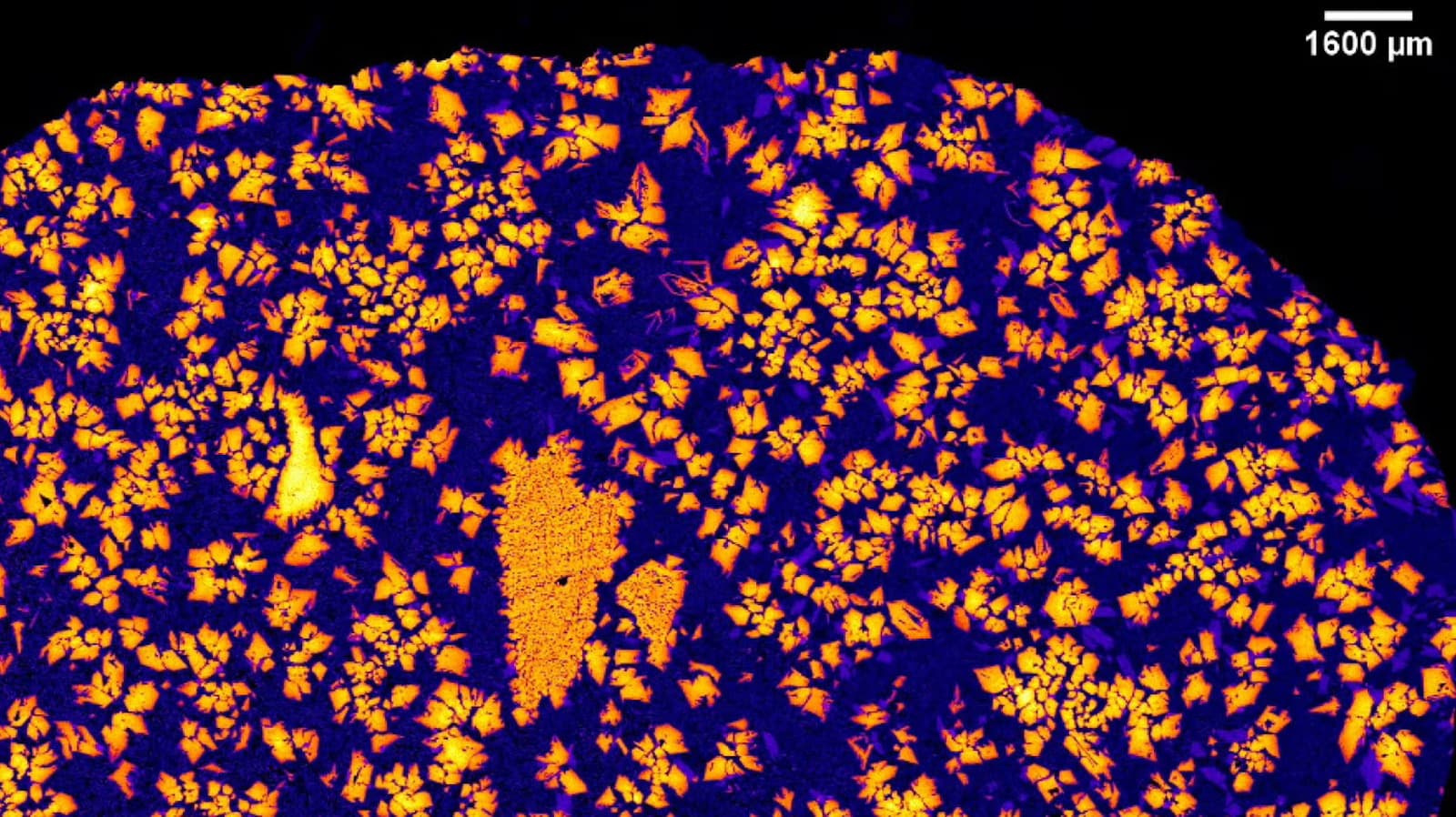
In another significant discovery, scientists found evidence of a protoplanet that orbited our sun 4.5 billion years ago in a meteorite found in Africa's Sahara Desert. The space rock, a rare angrite meteorite, is thought to have come from volcanic rock that can be traced back to the first few million years of the solar system's existence. The meteorite, dubbed NWA 12774, contains an aluminum-rich mineral crystal that indicates it formed under much greater pressure than an asteroid origin would allow for.
The team, led by Aaron Bell, an assistant research professor at the University of Colorado Boulder, found that the meteorite needed at least 17.5 kilobars of pressure to form, and the patterns of the crystals inside the meteorite suggest it formed at a shallow depth rather than deep underground. This suggests that the parent body was large, with a radius upwards of 1,118 miles, and could have been about the size of the moon or even as big as Mars.
The discovery of the protoplanet is significant because it provides evidence of a distinct and separate evolutionary path in planetary formation in the early history of our solar system. The materials that formed the angrite parent body are fundamentally different from the ingredients of Earth and Mars, and the meteorite preserved evidence of a completely different pathway through which early planets developed.
The findings were published in the journal Earth and Planetary Science Letters and provide new insights into the formation and evolution of our solar system. The discovery of the protoplanet and the measurement of the distant black hole are just two of the many significant scientific discoveries made this week. Other notable discoveries include the creation of a "universal vaccine" designed by AI, the successful testing of a vaccine with an AI-designed antigen, and the announcement of NASA's Nancy Grace Roman Space Telescope launch on August 30.
The University of Cambridge successfully tested a vaccine with an AI-designed antigen, which could potentially lead to the development of more effective vaccines against a range of diseases. The use of AI in vaccine design is a rapidly growing field, and the success of this trial is a significant step forward in the development of new vaccine technologies.
In other news, NASA's Mars MAVEN probe is dead, and Google has pledged to replenish more water than it uses at data centers by 2030. The Blue Origin CEO says New Glenn will fly again before the year ends, and NASA's Nancy Grace Roman Space Telescope is set to launch on August 30. These developments highlight the rapid progress being made in space exploration and the growing importance of private companies in the industry.
The measurement of the distant black hole and the discovery of the protoplanet are significant scientific breakthroughs that provide new insights into the formation and evolution of our universe. The use of AI in vaccine design and the development of new space technologies are also major advancements that have the potential to transform our understanding of the world and improve our daily lives. As scientists continue to explore the universe and develop new technologies, we can expect to see many more significant discoveries and innovations in the years to come.