
US and Iran exchange strikes in Gulf in latest test of ceasefire
"Tensions escalate as Iran retaliates with missile strikes, US defends regional maritime traffic. Ceasefire negotiations stall."
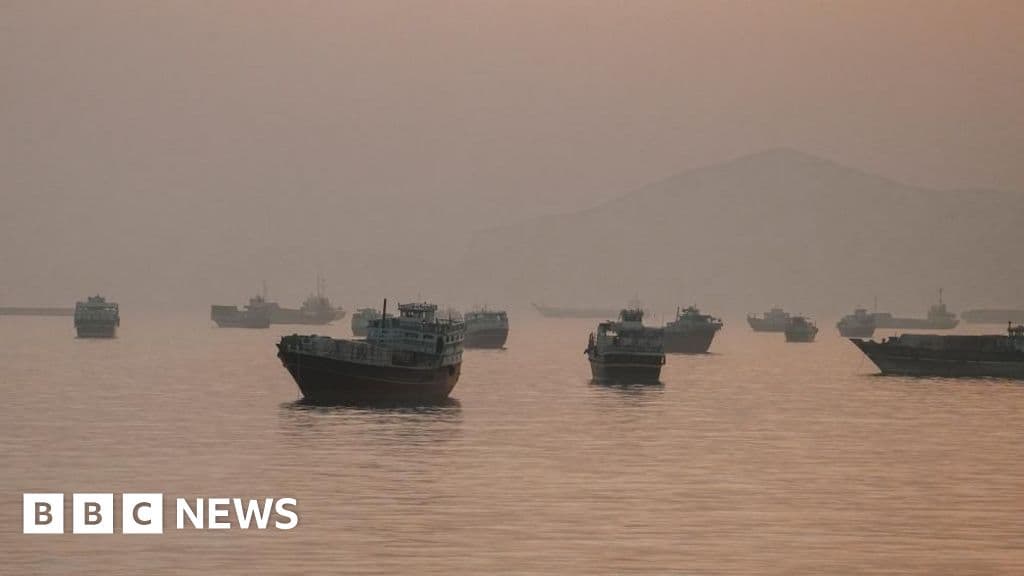
US and Iranian forces exchanged strikes in the Gulf, with American forces targeting Iranian drones and radar sites, and Iran firing missiles at US bases in Kuwait and Bahrain. The US military said the attacks were in response to four Iranian "one-way attack drones" launched towards the Strait of Hormuz, which posed an immediate threat to regional maritime traffic.
The drones were shot down, US Central Command said, adding that the attacks were a defensive measure to protect regional maritime traffic. Tehran called the US strikes a "flagrant" violation of the ceasefire agreement between the two countries. Iran retaliated by firing ballistic missiles at two US air bases in Kuwait, and US Navy facilities in Bahrain, Iran's Irib news agency reported.
Bahrain and Kuwait both condemned the attacks, saying the drone and missile fire had been successfully repelled. Centcom said initial assessments showed that of the seven Iranian missiles fired at the two Gulf states, six were intercepted and one did not reach its target. The United Arab Emirates and Qatar also denounced the Iranian attacks on their Gulf neighbours.
The Iranian foreign ministry said in a statement that the US strikes on radar installations in Sirik and at Qeshm island were a "flagrant" violation of the ceasefire and "an attack on the national sovereignty and territorial integrity of the Islamic Republic of Iran". The statement added that the US attack demonstrates this country's complete disregard for the principles of international law and the United Nations Charter.
Iran's Islamic Revolution Guard Corps said it had hit "enemy bases" as retaliation to the American strikes. There have been several such exchanges of fire, threatening the ceasefire that has been in place since April. However, despite the conflict between the two nations, the US has granted visas to Iran's World Cup football team, ahead of their first match in Los Angeles on 15 June.
It is the first time the competition will see a host nation receive the team of a country it is at war with. The move has been seen as a diplomatic gesture, but its impact on the conflict remains to be seen. The attacks occurred as ceasefire negotiations between the US and Iran stalled, with a deal to end the war failing to advance, and US media reporting that President Donald Trump had requested changes to the terms of an agreement.
On Monday, Iran's foreign ministry spokesman said the US was "constantly changing its views and putting forward new or contradictory demands". The US and Israel launched wide-ranging strikes on Iran on 28 February, sparking conflict across the Middle East. Iran responded by attacking Israel and US-allied states in the Gulf, and effectively closing the Strait of Hormuz, through which around 20% of the world's oil and liquefied natural gas travels.
That oil comes not only from Iran, but also Gulf states such as Iraq, Kuwait, Qatar, Saudi Arabia and the UAE. The closing of the strait sent oil prices soaring globally. Shortly after a ceasefire was agreed in early April, the US established a blockade of Iranian ports, which Trump said would remain "in full force and effect until an agreement is reached, certified, and signed".
The conflict has had significant implications for the global economy, with oil prices fluctuating wildly in response to the attacks. The situation remains volatile, with both sides digging in and refusing to back down. The US has maintained that it will continue to defend its interests in the region, while Iran has vowed to respond to any further attacks.
As the situation continues to escalate, the international community is watching with bated breath, hoping that a peaceful resolution can be found. The US and Iran have been at odds for decades, and the current conflict is just the latest chapter in a long and complex history. The stakes are high, with the potential for the conflict to spread and draw in other nations.
The US has been working to build a coalition of nations to support its efforts in the region, but so far, few countries have been willing to take a strong stance. The European Union has called for calm and restraint, but has not taken any concrete actions to intervene. The United Nations has also issued statements calling for peace, but its ability to enforce a ceasefire is limited.
In the meantime, the people of Iran and the US are paying the price for the conflict. The economic sanctions imposed by the US have had a devastating impact on the Iranian economy, with widespread poverty and unemployment. The US has also faced significant costs, with the deployment of troops and equipment to the region costing billions of dollars.
The conflict has also had a significant human cost, with countless innocent civilians caught in the crossfire. The situation is a stark reminder of the devastating consequences of war and the need for diplomatic solutions to conflicts. As the US and Iran continue to exchange blows, the world can only hope that a peaceful resolution can be found before it's too late.
The granting of visas to Iran's World Cup football team is a small glimmer of hope in an otherwise bleak situation. It shows that even in the midst of conflict, there is still room for diplomacy and cooperation. The World Cup is a symbol of international unity and cooperation, and the participation of Iran's team is a reminder that even in the darkest of times, there is still a way forward.
As the world watches the conflict between the US and Iran unfold, one thing is clear: the situation is complex and multifaceted, with no easy solutions. The international community must continue to push for a peaceful resolution, and the US and Iran must be willing to negotiate and compromise. The alternative is a devastating and costly war that will have far-reaching consequences for the entire world.

