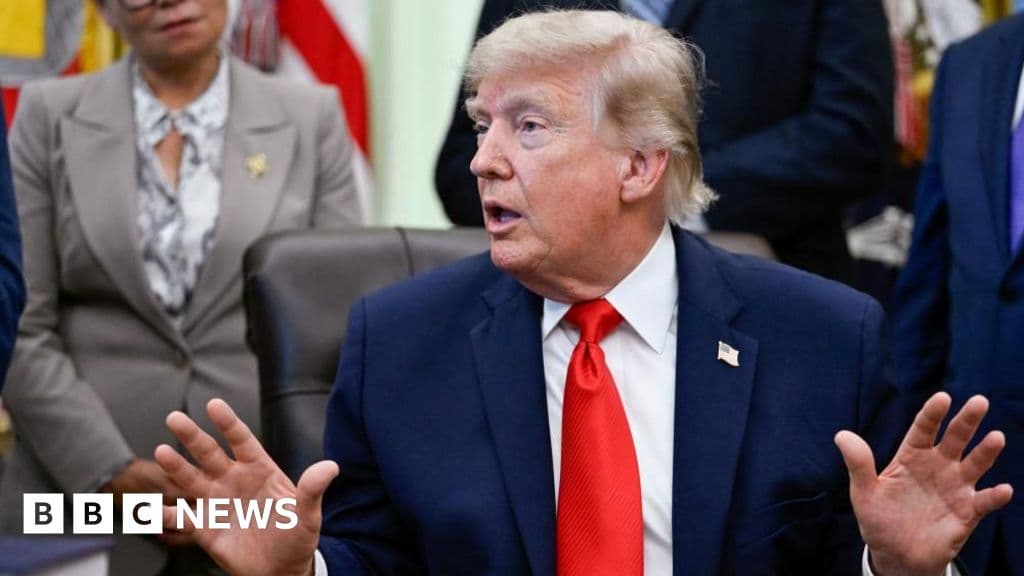
President Donald Trump announces a US-Iran deal to be signed on Sunday.
"Tensions rise as Iran casts doubt on timing, despite Trump's announcement. A delicate peace process unfolds."
The deal aims to end fighting between the US and Iran, with the Strait of Hormuz, a key shipping route, set to be "open to all" once agreed. However, Iranian foreign ministry spokesman Esmail Baghaei has expressed caution over the timeline, saying the signing may not occur on Sunday as claimed by Trump.
In a post on social media, Trump stated that the deal would be signed on Sunday, and the Hormuz Strait would be accessible to all parties immediately after. He also mentioned that, at a later time, the US would address Iran's enriched uranium stockpiles, referring to it as "Nuclear Dust" that would be destroyed. This statement comes amid decades of accusations by Western countries that Iran has been attempting to build a nuclear bomb, which Iran has consistently denied, claiming its nuclear program is for peaceful purposes.
Pakistan, a key mediator in the talks, has also announced that the deal is expected to be finalized within 24 hours, with preparations underway for an electronic signing. Pakistani Prime Minister Shehbaz Sharif stated that "we are closer to a peace deal than ever before" and that technical-level talks would follow the signing. This development comes after months of negotiations, with various versions of an agreement having been expected but not completed in the later stages.
The conflict between the US and Iran began with US and Israeli strikes across Iran on February 28, prompting Iran to attack Israel and US-allied states in the Gulf, as well as effectively closing the Strait of Hormuz. Despite a ceasefire agreement in April, the US and Iran have exchanged intermittent fire, with Israel carrying out an air strike on the southern suburbs of Beirut, a Hezbollah stronghold, on Sunday.
The US-Iran deal has significant implications for the region, particularly with regard to the conflict between Israel and Hezbollah in Lebanon. While the deal is expected to bring an end to the fighting between the US and Iran, it does not directly address the conflict between Israel and Hezbollah. Israel has insisted that it will continue to strike Hezbollah in response to its attacks in northern Israel, despite the US-Iran deal.
Trump's efforts to extricate himself from the conflict in the Middle East have been complicated by Israel's ongoing operation in Lebanon. The US has historically been a strong supporter of Israel, and Trump has typically been an ardent proponent of Israel during his time in the White House. However, his attempts to end the conflict in the region have been frustrated by Israel's continued strikes against Hezbollah.
The deal also has significant economic implications for Iran, with US officials confirming that economic benefits for Iran would depend on Tehran meeting its obligations. The agreement is expected to bring an end to the conflict between the US and Iran, which has had a significant impact on the global economy, particularly with regard to oil and gas prices.
In recent months, variations of an agreement have been expected several times but have not been completed in the later stages. The latest development comes after Iran's Foreign Minister Seyed Abbas Araghchi announced that a deal with the US was close, with talks on Iran's nuclear program set to begin later. The US-Iran deal is a significant step towards ending the conflict in the region, but its success will depend on the ability of all parties to meet their obligations and maintain the fragile peace.
As the situation continues to unfold, it remains to be seen whether the US-Iran deal will be successful in bringing an end to the conflict in the region. The deal has significant implications for the global economy, as well as for the security of the region. With the Strait of Hormuz set to be "open to all" once the deal is agreed, the global economy is likely to see a significant boost, particularly with regard to oil and gas prices.
The US-Iran deal is also significant in terms of its impact on the relationship between the US and Iran. The deal marks a significant shift in the relationship between the two countries, which has been strained for decades. The success of the deal will depend on the ability of both parties to maintain the fragile peace and to meet their obligations.
In conclusion, the US-Iran deal is a significant development in the region, with significant implications for the global economy and the security of the region. The deal has the potential to bring an end to the conflict between the US and Iran, but its success will depend on the ability of all parties to meet their obligations and maintain the fragile peace. As the situation continues to unfold, it remains to be seen whether the US-Iran deal will be successful in achieving its goals.