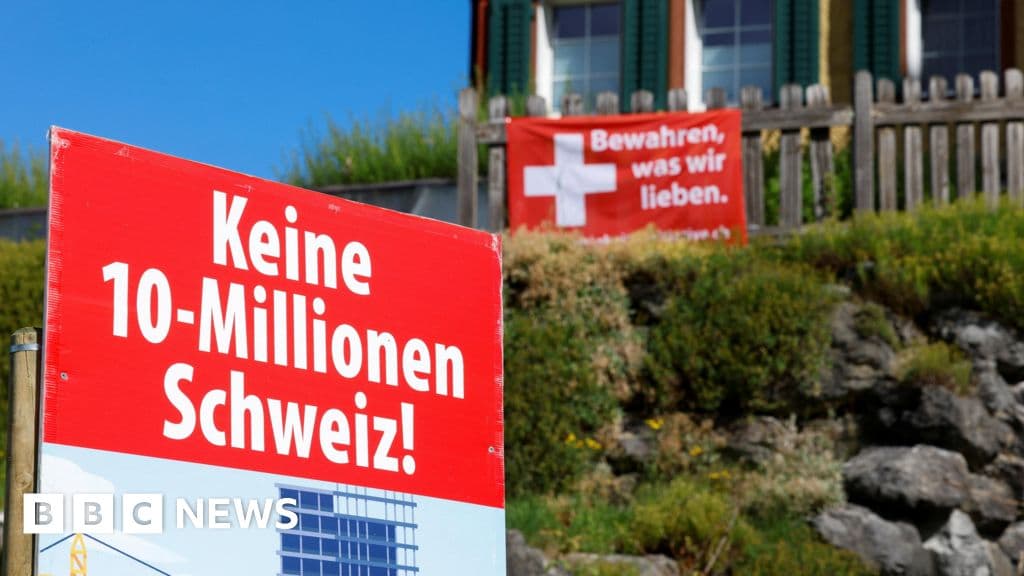
Swiss voters reject 10 million population cap, early projections say
"A divisive vote sparks relief and concern among citizens and business leaders. The outcome may impact Switzerland's relationship with the EU."
Switzerland's voters have rejected a proposal to limit the country's population to 10 million. The vote, which took place on a recent Sunday, saw 55% of participants voting against the proposal, with 45% in favor. The outcome is a significant development in Switzerland's political landscape, with implications for the country's immigration policies and its relationship with the European Union.
The proposal, which was put forward by the right-wing Swiss People's Party, aimed to cap the country's population at 10 million. The party argued that this would help reduce pressure on public services, housing, and the environment. However, critics of the proposal argued that it was motivated by anti-immigrant sentiment and would have negative consequences for the country's economy and social fabric.
Switzerland's population has grown rapidly in recent years, from 7.3 million in 2002 to 9.1 million today. The country has a significant immigrant population, with 27% of residents holding non-Swiss citizenship. The Swiss People's Party has long campaigned on an anti-immigration platform, frequently blaming asylum seekers and minorities for societal problems.
The vote was closely watched by business leaders and politicians in Switzerland and beyond. The country's access to the EU's single market is dependent on its commitment to free movement of people, and a yes vote would have likely led to the termination of this agreement. Swiss business leaders warned that this would have severe consequences for the country's economy, with over half of all Swiss products being sold in the EU.
The outcome of the vote is a relief for many in Switzerland's business community. Rudolf Minsch, chief economist at Economiesuisse, said that a yes vote would have led to "challenges in our relations with the European Union." He added that the EU is Switzerland's most important trading partner, and it is in the country's interest to have stable and clear relationships with its main trading partner.
However, the vote is not just about economics; it also has significant social and political implications. The Swiss People's Party has a long history of campaigning on anti-immigrant issues, and the proposal was seen by many as an attempt to scapegoat migrants for the country's problems. Helin Genis, a 31-year-old Social Democrat, said that viewing problems through the lens of migration does not lead to solutions, but to division.
The vote has also sparked concerns about the country's ability to attract and retain skilled workers. Half of all workers in Switzerland are employed in sectors that rely on immigrant labor, such as tourism, healthcare, and social care. A yes vote would have likely led to labor shortages and difficulties in filling key positions.
In the lead-up to the vote, two young politicians with opposing views on limiting the Swiss population spoke to the BBC. Nils Fiechter, 29, who represents the Swiss People's Party in canton Bern's parliament, argued that the country has "lost control" of immigration and that it is leading to a range of social and economic problems. However, his views have been criticized by many, and he has a controversial past, having been convicted of racial discrimination in 2022.
In contrast, Helin Genis argued that the problems facing Switzerland, such as housing shortages and gridlocked traffic, are not caused by migrants but by a range of factors, including government policies and economic conditions. She said that scapegoating migrants is not a solution to these problems and that it only leads to division and social unrest.
The outcome of the vote is a significant development in Switzerland's political landscape, and it will have implications for the country's relationship with the EU and its approach to immigration. While the Swiss People's Party has lost this battle, it is likely that the issue of immigration will continue to be a contentious one in Swiss politics. The country's system of direct democracy means that all major decisions are taken via the ballot box, and campaigners can easily gather the 100,000 signatures needed to trigger a nationwide vote.
As Switzerland looks to the future, it will need to balance its desire to control immigration with its need to attract and retain skilled workers. The country will also need to navigate its complex relationship with the EU, which is its most important trading partner. The outcome of the vote is a relief for many, but it is also a reminder that the issue of immigration remains a divisive and contentious one in Swiss politics.
In the aftermath of the vote, Swiss politicians and business leaders will need to work together to find solutions to the country's social and economic problems. This will require a nuanced and evidence-based approach to immigration, one that takes into account the needs of the economy and the concerns of citizens. It will also require a commitment to social cohesion and inclusivity, and a recognition that migrants are an integral part of Swiss society.
As the country moves forward, it will be important to remember that the issue of immigration is not just about numbers or policies; it is also about people and their lives. The vote has shown that the Swiss people are committed to a more inclusive and open approach to immigration, and it is now up to politicians and business leaders to turn this commitment into reality.