
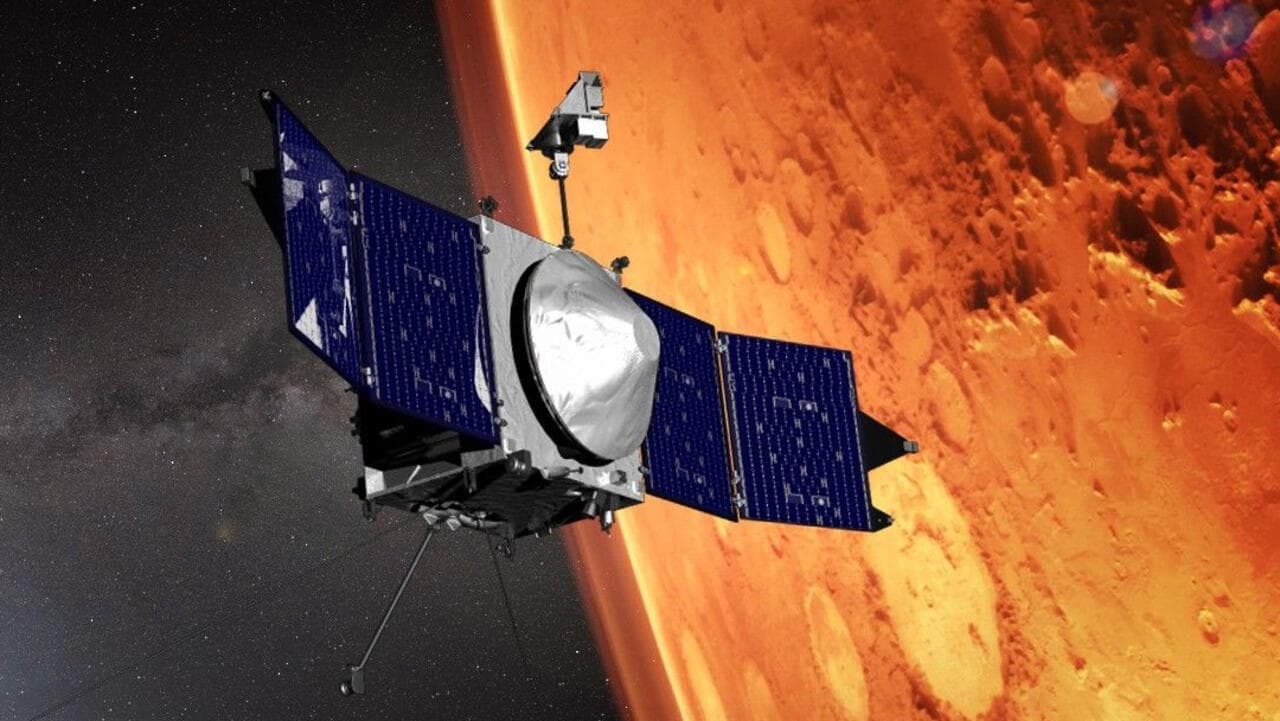
NASA Confirms End Of Decade-Long MAVEN Mars Mission
"NASA's decade-long MAVEN mission revolutionized our understanding of Mars' atmospheric evolution before falling silent in 2025, leaving scientists to ponder the Red Planet's mysterious climate history."
NASA confirmed the end of its decade-long MAVEN Mars mission Wednesday after the spacecraft fell silent for six months, marking the conclusion of a revolutionary study into the Red Planet's atmospheric evolution.
The Mars Atmosphere and Volatile Evolution orbiter, affectionately known as MAVEN, entered Martian orbit in 2014 with a planned mission duration of just one to two years. Instead, it operated for an astonishing twelve years, far exceeding its original design specifications and becoming one of the most successful Mars missions in NASA's history. The spacecraft's unexpected silence in December 2025, however, has forced the agency to formally terminate the mission that fundamentally reshaped our understanding of planetary evolution.
What made MAVEN truly exceptional was its ability to transform Mars from a distant, barren world into a dynamic laboratory for understanding atmospheric processes. The spacecraft's instruments meticulously measured how solar wind stripped away Mars's atmosphere over billions of years, providing crucial insights into why the Red Planet transformed from a potentially habitable world to the cold, dry environment we observe today. This research has profound implications not only for Mars but for understanding climate evolution across all rocky planets, including Earth.
Dr. Shannon Curry, MAVEN's principal investigator and an astrophysics professor at UC Berkeley, described the mission as "the best Mars mission ever" during Wednesday's announcement. Her assessment reflects more than just personal sentiment—it captures the mission's transformative scientific impact. MAVEN enabled scientists to develop unprecedented models of atmospheric escape mechanisms, processes that continue to shape Mars's climate and may have determined its habitability potential over geological timescales.
The mission's longevity and scientific return represent a remarkable achievement in space exploration engineering. MAVEN was designed to withstand the harsh Martian environment for a limited period, yet its systems continued functioning for more than a decade—a testament to the robustness of its design and the skill of NASA's engineers. The spacecraft endured extreme temperature variations, intense solar radiation, and the constant bombardment by micrometeoroids that degrade spacecraft components over time.
NASA's decision to end the mission comes after months of unsuccessful attempts to reestablish contact with the orbiter. The agency believes MAVEN remains in orbit around Mars, but its silence suggests a critical system failure—likely in the power, communications, or attitude control systems that are essential for maintaining contact with Earth. The investigation into the precise cause of the failure will provide valuable data for future mission design, potentially revealing vulnerabilities that engineers can address in upcoming interplanetary missions.
Beyond its primary scientific objectives, MAVEN served as an indispensable communications relay between Earth and NASA's surface assets on Mars. The spacecraft relayed data from rovers and landers on the Martian surface, providing a critical link in the network that enables scientific operations on the Red Planet. With MAVEN's retirement, NASA must now rely on other orbiters—such as the Mars Reconnaissance Orbiter and the upcoming Mars Telecommunications Orbiter—to maintain this vital communications infrastructure.
The loss of MAVEN occurs at a critical juncture in Mars exploration. NASA, alongside international partners and commercial entities, is planning increasingly ambitious missions to the Red Planet. The agency's Artemis program aims to establish a human presence on the Moon as a stepping stone to Mars, while private companies like SpaceX are developing their own Mars exploration architectures. In this context, MAVEN's atmospheric data becomes even more valuable, providing essential baseline information for future mission planning and hazard assessment.
The mission's legacy extends beyond Mars itself. By studying atmospheric escape on Mars, scientists gained insights into similar processes that occur on Earth and other planets. This comparative planetology approach has revolutionized our understanding of how stellar activity interacts with planetary atmospheres—a field that has taken on new urgency as we search for potentially habitable exoplanets elsewhere in the galaxy. MAVEN's discoveries have directly informed the design of instruments for upcoming missions to Venus and other rocky planets.
NASA's exploration program chief Tiffany Morgan emphasized that MAVEN "profoundly advanced our understanding of Mars's atmosphere, climate history, and habitability." This understatement captures the mission's transformative impact. Before MAVEN, our understanding of Mars's atmospheric evolution was fragmented and incomplete. The spacecraft's comprehensive measurements allowed scientists to construct detailed models of how solar wind and other space weather phenomena have eroded Mars's atmosphere over billions of years, potentially explaining the planet's transformation from a potentially habitable world to its current state.
The termination of MAVEN also marks a turning point in NASA's Mars exploration strategy. The agency is increasingly focusing on sample return missions and human exploration, shifting from pure science to more applied objectives. While MAVEN's end is a significant loss for the scientific community, it also reflects the maturation of Mars exploration as a field. Future missions will build directly on MAVEN's discoveries, using its atmospheric data as a foundation for increasingly sophisticated investigations.
As NASA mourns the loss of MAVEN, the mission's scientific legacy remains intact. The spacecraft collected twelve years of atmospheric data that will continue to fuel research for decades to come. Its instruments measured the composition, structure, and dynamics of Mars's upper atmosphere in unprecedented detail, providing a baseline against which future measurements can be compared. This long-term data record is invaluable for understanding not just Mars's current climate but its evolution over geological time.
The mission's conclusion also highlights the inherent risks and uncertainties of space exploration. Despite meticulous planning and engineering, spacecraft can and do fail unexpectedly. MAVEN's extended mission duration likely increased the probability of system failure, as components gradually degraded over time. This reality serves as a reminder that space exploration remains an inherently challenging endeavor, requiring constant innovation and redundancy to mitigate risks.
Looking ahead, the Mars exploration community will need to address the gap left by MAVEN's retirement. While other orbiters can provide some atmospheric data, none match MAVEN's specialized instruments for studying atmospheric escape processes. Future missions will need to incorporate similar capabilities to maintain our understanding of Mars's atmospheric evolution. NASA's upcoming Mars missions, including the Mars Sample Return and potential crewed missions, will benefit greatly from the atmospheric context that MAVEN provided.
The end of MAVEN also raises questions about the future of long-duration Mars missions. With successful missions like MAVEN, Mars Reconnaissance Orbiter, and Mars Odyssey operating well beyond their design lifetimes, NASA may reconsider its approach to mission planning. Future missions could incorporate design features specifically intended to enable extended operations, recognizing that the scientific return from longer missions often justifies the additional investment.
As we look to the future of Mars exploration, MAVEN's legacy will endure as a model of scientific excellence and engineering achievement. The mission transformed our understanding of Mars's atmospheric evolution and provided crucial insights into planetary habitability. While the spacecraft itself may be silent, the knowledge it gathered continues to echo through the scientific community, shaping our understanding of Mars and its place in the solar system. The end of MAVEN marks not just the conclusion of a mission, but the continuation of a scientific journey that will unfold for generations to come.

