Alaskans will be flying blind after NSF decommissions ocean monitoring network
"Alaska's fishing industry faces uncertainty as a crucial ocean monitoring system is decommissioned, threatening the state's economy and environment."
Alaska's National Science Foundation decommissions a $368 million ocean monitoring network. The decision affects Alaska's multibillion-dollar fishing industry and vulnerable coastal communities, which rely on real-time data from the Ocean Observatories Initiative to plan and prepare for the future.
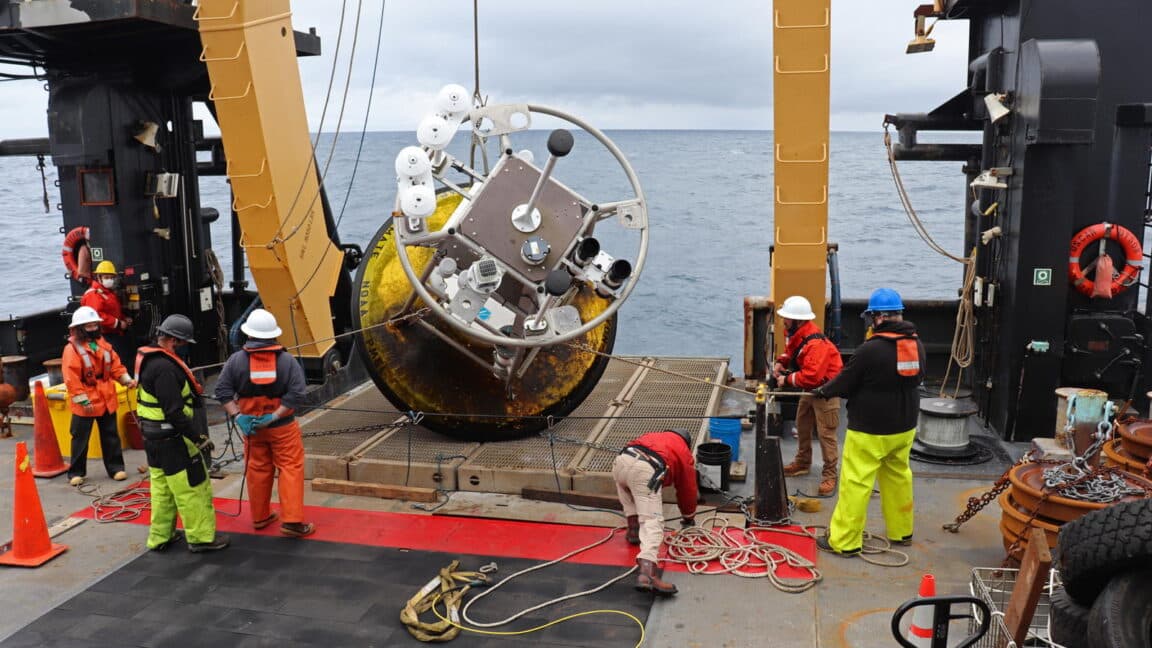
The Ocean Observatories Initiative, a network of nearly 900 deep-sea instruments, tracks ocean chemistry, wave action, water temperature, salinity, and other metrics, providing crucial information for scientists, fishery managers, and coastal hazard planners. Jan Newton, University of Washington affiliate professor of biological oceanography, emphasizes the importance of this data, stating that it helps "see where we're going and what's coming at us." The loss of this network will leave Alaska's fishing industry and coastal communities without vital information to manage fisheries and prepare for natural disasters.
The National Science Foundation's decision to decommission the network has sparked concern among fishing circles in Alaska, where the commercial seafood industry employs nearly 42,000 people and generates $5.3 billion in revenue. Michelle Stratton, executive director of the Alaska Marine Community Coalition, warns that the loss of Ocean Station Papa, a deep-ocean observing system in the Gulf of Alaska, will deprive the state of vital data on ocean changes. "We're in the middle of salmon crashes, crab collapses, and repeated marine heatwaves, and this decision takes away the data we rely on to understand what's happening and how to manage these fisheries," Stratton said.
The National Science Foundation attributes its decision to a "nimbler approach" to prioritize support for evolving scientific priorities and emerging technologies. Spokesperson Cassandra Eichner assures that all previously collected data will remain accessible and that the NSF remains committed to ocean science. However, critics argue that the decision aligns with Project 2025, a conservative blueprint that casts government-sponsored oceanic and atmospheric research as a source of "climate alarmism."
Rick Thoman, climate specialist with the University of Alaska Fairbanks, highlights the significance of the Ocean Observatories Initiative in shedding light on the deep, dark depths of the ocean. "Losing the information provided by Ocean Station Papa on how the ocean is changing with a warming climate is like driving down a dark freeway with no lights on," said Carol Janzen, oceanographer with the Alaska Ocean Observing System. The loss of this network will hinder scientists' ability to understand the impacts of climate change on Alaska's oceans and fisheries.
Alaska has been experiencing intense marine heatwaves, population crashes of species like Chinook salmon and snow crab, and battering storms, including Typhoon Halong. The state's fast-warming climate makes it essential to maintain a robust ocean monitoring system. Thoman emphasizes that the value of the network lies in its ability to provide oceanographic information from the entire water column, enabling scientists to understand the complex interactions within the ocean.
The decommissioning of the Ocean Observatories Initiative has far-reaching implications for Alaska's economy, environment, and communities. As the state struggles to manage its fisheries and respond to climate change, the loss of this vital monitoring system will exacerbate existing challenges. The decision by the National Science Foundation to prioritize emerging technologies over established research infrastructure raises questions about the commitment to understanding and addressing the impacts of climate change on Alaska's oceans and communities.
In the face of these challenges, it is crucial for scientists, policymakers, and stakeholders to work together to find alternative solutions for maintaining a robust ocean monitoring system in Alaska. This may involve exploring partnerships with other research institutions, government agencies, or private organizations to continue collecting vital data on ocean changes. The fate of Alaska's fishing industry, coastal communities, and environment depends on the ability to access accurate and reliable information about the state's oceans. As the National Science Foundation reconsiders its priorities, it must weigh the long-term consequences of its decisions on the health and resilience of Alaska's marine ecosystems.
The upcoming loss of the Ocean Observatories Initiative serves as a stark reminder of the importance of continued investment in ocean science and research infrastructure. As the world grapples with the challenges of climate change, it is essential to prioritize the collection of accurate and reliable data on ocean changes. The consequences of inaction will be felt not only in Alaska but also in coastal communities around the world, highlighting the need for a coordinated and sustained effort to monitor and understand the world's oceans.
Ultimately, the decision to decommission the Ocean Observatories Initiative underscores the complex and often competing priorities that shape science policy. As scientists, policymakers, and stakeholders navigate these challenges, they must remain committed to advancing our understanding of the oceans and their role in the Earth's system. The future of Alaska's fishing industry, coastal communities, and environment depends on it.