
US and Iran exchange strikes across Middle East for second day in a row
"Tensions escalate as Iran targets US bases, oil tankers caught in crossfire. Regional stability hangs in balance."
US and Iranian forces exchanged strikes across the Middle East for a second consecutive day, with the US targeting military sites in southern Iran and Iran responding with attacks on US assets in Bahrain, Kuwait, and Jordan.
The latest escalation began when US Central Command launched a wave of "self-defense strikes" against Iranian military, surveillance, and radar sites. This move came hours after President Donald Trump vowed to hit Iran "hard" in response to recent provocations. Iran's foreign ministry swiftly condemned the US action, stating that it violated the two-month-old ceasefire and rendered it "practically meaningless".
Iran retaliated with a round of strikes targeting US military assets in the region. The Islamic Revolutionary Guard Corps (IRGC) claimed to have fired ballistic missiles at a US command centre in Jordan, destroying "a large number" of US fighter jets and facilities. Jordanian state media reported that 20 missiles were intercepted and shot down by the country's air defence systems, with no human casualties or material damage.
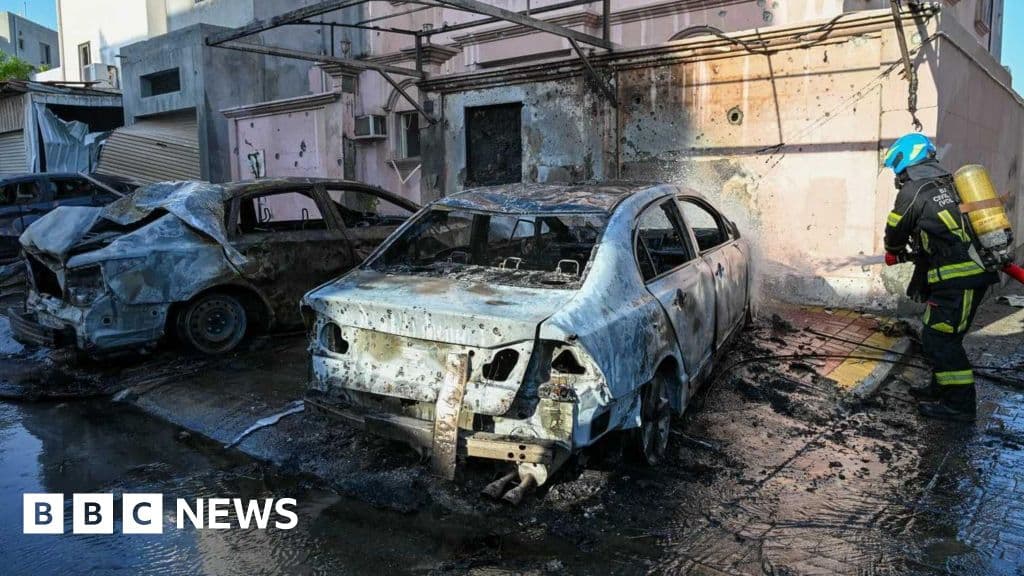
In Bahrain, the interior ministry reported that air raid sirens were activated, and falling shrapnel from intercepted Iranian drones damaged homes and vehicles in the capital Manama and Hamad Town. An 11-year-old girl was treated for a minor injury, with the ministry condemning Iran's strikes as "sinful". Kuwait's Army also reported intercepting "hostile aerial targets", temporarily closing its airspace before reopening it early on Thursday.
The IRGC also claimed to have hit two oil tankers passing through the Strait of Hormuz, a crucial shipping channel. However, there was no immediate confirmation of a strike, and US Central Command stated that commercial ships were continuing to transit in and out of the strait. Oil prices rose in response to the apparent attack, with Brent crude oil climbing to around $95 a barrel after a 2% increase.
The exchange of strikes is the latest development in a series of escalating tensions between the US and Iran. In April, the two countries agreed to a ceasefire, but recent efforts to broker negotiations have stalled, and attacks have grown more frequent. The US has blamed Iran for an attack that downed an American helicopter, while the IRGC has targeted US bases across the Middle East.
UN Secretary General António Guterres warned that the Middle East was "being pulled deeper into crisis", with the ceasefire resembling "a lesser-fire". The situation remains volatile, with both sides dug in and refusing to back down. As the conflict continues to escalate, the risk of further violence and destabilization in the region grows.
The US and Iran have been at odds for decades, with tensions simmering over issues such as nuclear proliferation, terrorism, and regional influence. The current conflict has its roots in the US withdrawal from the Joint Comprehensive Plan of Action (JCPOA), a nuclear deal signed in 2015. Since then, the US has reimposed sanctions on Iran, leading to a significant deterioration in relations.
The international community is watching the situation with growing concern, with many calling for calm and restraint. The European Union has urged both sides to respect the ceasefire and return to negotiations, while Russia and China have also weighed in, calling for a peaceful resolution to the conflict.
As the situation continues to unfold, one thing is clear: the conflict between the US and Iran has the potential to destabilize the entire region. With both sides refusing to back down, the risk of further violence and escalation grows by the day. The international community must come together to find a peaceful solution to this crisis before it's too late.


