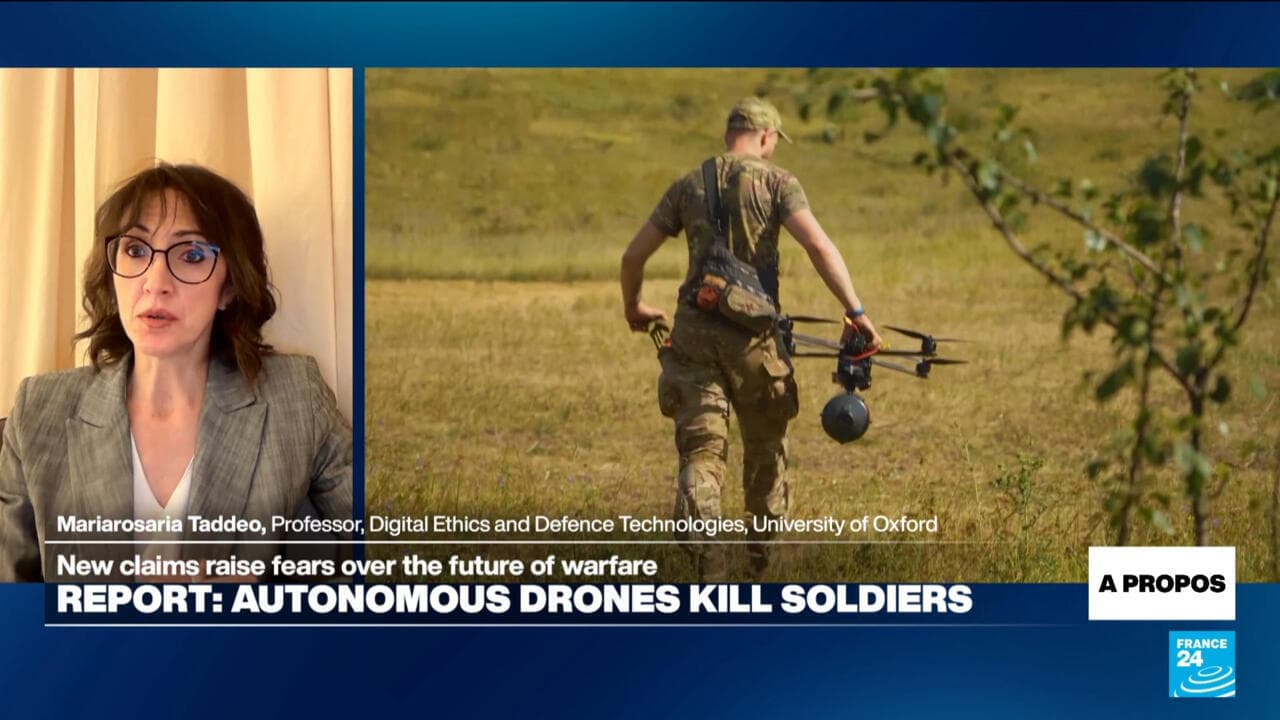
'Civilians will be put in harm's way' expert warns as first autonomous drone kills revealed
"Casualties confirmed in a secretive test, sparking concerns over civilian safety. Experts warn of indiscriminate attacks."
Ukraine's defense industry conducted a test of fully autonomous drones two years ago. Professor Mariarosaria Taddeo, a leading expert in digital ethics and defense technologies at the University of Oxford, revealed that these drones were designed to destroy anything in a given area, resulting in confirmed casualties. This revelation has sparked widespread concern over the potential risks and consequences of using such autonomous systems in warfare.
The use of autonomous drones in warfare is not a new concept, but the idea of fully autonomous systems that can select and engage targets without human intervention is a relatively recent development. These systems use advanced algorithms and artificial intelligence to navigate and identify targets, but they lack the ability to discriminate between combatants and non-combatants. According to Taddeo, these systems "are fully indiscriminate, whether the system sees a combatant, a child, an old person, it won't be able or won't be designed to discriminate, so civilians are going to be put in harm's way."
The test, which took place in Ukraine, involved autonomous drones that were programmed to destroy anything in a given area. The exact details of the test, including the location and the number of casualties, have not been disclosed. However, the fact that casualties were confirmed has raised serious concerns about the potential consequences of using such systems in real-world conflicts. The use of autonomous drones in warfare raises a number of ethical and legal questions, including the issue of accountability and the potential for unintended consequences.
One of the main concerns surrounding the use of autonomous drones is the lack of transparency and accountability. When a human soldier makes a mistake, they can be held accountable for their actions. However, when an autonomous system makes a mistake, it is not clear who should be held accountable. Is it the manufacturer of the system, the military commander who deployed it, or the programmer who wrote the algorithm? This lack of accountability raises serious concerns about the potential for abuse and the potential for autonomous systems to be used in ways that violate international humanitarian law.
The development and use of autonomous drones also raises questions about the future of warfare. As autonomous systems become more advanced and more prevalent, there is a risk that they could be used to launch attacks without human intervention. This could lead to a new era of warfare, in which autonomous systems are used to launch attacks without the need for human decision-making. However, this also raises concerns about the potential for autonomous systems to be used in ways that are not in line with international humanitarian law.
The use of autonomous drones in warfare is not just a technical issue, but also a legal and ethical one. The Geneva Conventions, which govern the conduct of warfare, require that combatants distinguish between military targets and civilians. However, autonomous systems are not capable of making this distinction, which raises serious concerns about their use in warfare. According to Taddeo, "the use of autonomous systems in warfare is a clear violation of international humanitarian law, and it's a very serious concern."
The development and use of autonomous drones is a complex issue that requires careful consideration of the potential risks and consequences. While autonomous systems have the potential to revolutionize the way that warfare is conducted, they also raise serious concerns about the potential for abuse and the potential for unintended consequences. As the use of autonomous drones becomes more prevalent, it is essential that we carefully consider the implications of this technology and work to develop clear guidelines and regulations for its use.
In recent years, there has been a growing trend towards the development and use of autonomous systems in warfare. This trend has been driven by advances in technology, including the development of more advanced algorithms and artificial intelligence. However, this trend has also raised serious concerns about the potential risks and consequences of using autonomous systems in warfare. According to a report by the United Nations, the use of autonomous systems in warfare could lead to a new era of warfare, in which autonomous systems are used to launch attacks without human intervention.
The report, which was published in 2020, warned that the use of autonomous systems in warfare could have serious consequences, including the potential for unintended harm to civilians. The report also warned that the use of autonomous systems could lead to a new era of warfare, in which autonomous systems are used to launch attacks without human intervention. This could lead to a significant increase in the number of casualties, as well as a significant increase in the number of civilian casualties.
The use of autonomous drones in warfare is a complex issue that requires careful consideration of the potential risks and consequences. While autonomous systems have the potential to revolutionize the way that warfare is conducted, they also raise serious concerns about the potential for abuse and the potential for unintended consequences. As the use of autonomous drones becomes more prevalent, it is essential that we carefully consider the implications of this technology and work to develop clear guidelines and regulations for its use.
In conclusion, the use of autonomous drones in warfare is a serious concern that requires careful consideration of the potential risks and consequences. The development and use of autonomous systems raises a number of ethical and legal questions, including the issue of accountability and the potential for unintended consequences. As the use of autonomous drones becomes more prevalent, it is essential that we work to develop clear guidelines and regulations for its use, and that we carefully consider the implications of this technology.