
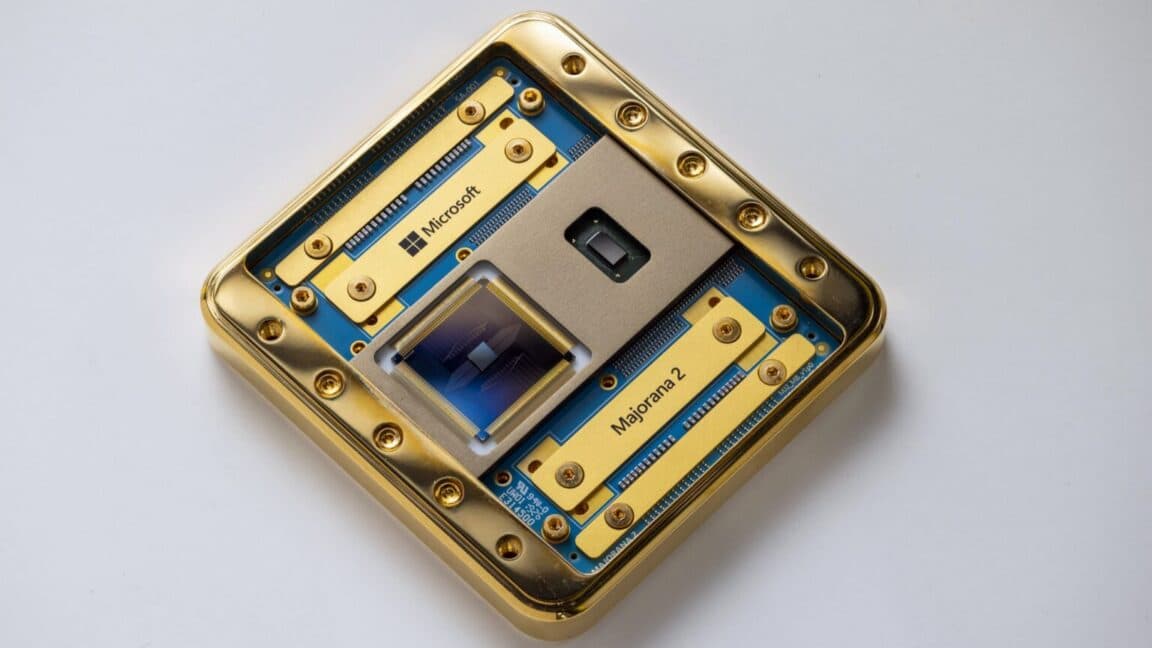
Microsoft Quantum Advances Signal Shift Toward Practical Applications
"Tech giants and startups race toward quantum advantage, with Microsoft's topological qubits showing unprecedented stability, signaling the field is maturing beyond theoretical promise."
Quantum computing pioneers from Microsoft, Atom Computing, and EeroQ have announced significant progress in their respective technologies, marking a critical shift from theoretical promise to practical implementation in the race toward quantum advantage.
The quantum computing landscape, once dominated by theoretical physicists and academic researchers, has evolved into a fiercely competitive arena where tech giants and nimble startups alike pour billions into developing the next generation of computational power. Recent announcements from three key players—Microsoft with its topological qubits, Atom Computing with its atom-based quantum processors, and EeroQ with its quantum annealing technology—reveal a maturing industry focused not just on headline-grabbing qubit counts, but on the foundational elements that will eventually make quantum computers useful for real-world applications.
Microsoft's breakthrough in topological qubits represents perhaps the most technically significant of the recent advances. After years of skepticism following some retracted research and noisy experimental results, the company has achieved a remarkable 20,000-fold improvement in qubit stability. By switching from aluminum to lead as the superconducting material and incorporating tin into the underlying semiconductor, Microsoft's team has dramatically extended the coherence time of their topological qubits from milliseconds to seconds. This stability—long the theoretical promise of topological qubits—represents a crucial step toward building quantum computers that can maintain complex quantum states long enough to perform meaningful computations.
"The stability we're seeing with these new materials validates our approach and puts us on a clear path toward building scalable topological quantum computers," said Krysta Svore, vice president of advanced quantum development at Microsoft. "While we still have significant challenges ahead in manipulating these qubits and implementing error correction, the fundamental physics is now working as theory predicted."
Atom Computing, which partners with Microsoft through Azure Quantum, has taken a different approach but demonstrated similar progress in practical quantum implementation. Their system uses neutral atoms trapped by laser arrays, with computation performed on the nuclear spins of these suspended atoms. In a new manuscript, the company detailed its development of an architecture that includes storage regions, operational zones, and backup atoms that can be deployed when primary atoms are lost or damaged. This redundancy capability represents a significant step toward fault-tolerant quantum computing, where the system can continue operating even when individual components fail.
"We're building quantum computers that don't just work in pristine laboratory conditions but can function in the messy reality of real-world deployment," said Rob Hays, CEO of Atom Computing. "Our approach to maintaining atomic arrays and implementing redundancy addresses one of the most fundamental challenges in quantum computing: error rates."
EeroQ, the third company in this trio of recent announcements, has focused on quantum annealing technology, which differs from the gate-based approaches of Microsoft and Atom. Quantum annealers excel at optimization problems and have found early applications in areas like logistics and materials science. EeroQ's recent progress involves scaling their quantum annealers while maintaining the low temperatures required for operation, a critical challenge for quantum technologies that must operate near absolute zero.
The quantum computing industry's maturation beyond pure research into practical implementation reflects broader trends in the technology sector. Where once quantum computing was discussed in terms of theoretical potential and distant milestones, the conversation has shifted to near-term applications and the engineering challenges of scaling existing technologies. This shift is particularly evident in the growing focus on error correction, fault tolerance, and system integration—elements that determine when quantum computing will transition from laboratory curiosity to commercial reality.
"The quantum computing field is entering its engineering phase, where the real work begins," said John Preskill, theoretical physicist and director of the Institute for Quantum Information and Matter at Caltech. "We're seeing companies tackle the mundane but essential problems of making quantum systems stable, scalable, and controllable—problems that will ultimately determine when quantum computers deliver on their promise."
Microsoft's topological qubit approach has always stood apart in the quantum landscape. Unlike the more conventional superconducting qubits pursued by companies like IBM and Google, or the trapped ion technologies championed by IonQ and Quantinuum, topological qubits rely on exotic quantum phenomena that emerge when particles are confined in specific ways. The fundamental promise of topological protection—that quantum information is stored in global properties of a system rather than vulnerable local states—has made this approach attractive despite significant engineering challenges.
The skepticism Microsoft faced in its early topological qubit research stemmed partly from the difficulty in definitively observing the predicted quantum phenomena. In 2021, the company had to retract a paper claiming to have observed evidence of Majorana zero modes—the exotic particles central to topological qubit operation—due to measurement inconsistencies. The recent breakthrough with lead-based nanowires represents a vindication of the company's approach, demonstrating that the underlying physics does work as predicted when engineered properly.
"The fact that Microsoft has achieved this level of stability with topological qubits is significant not just for Microsoft but for the entire field," said Scott Aaronson, theoretical computer scientist and director of the Quantum Information Center at UT Austin. "It proves that topological protection isn't just theoretical—it can be engineered into working systems. This gives the entire field confidence that quantum error correction, which relies on similar principles, can eventually be made practical."
Atom Computing's approach, while technologically distinct from Microsoft's, shares a focus on practical implementation over headline qubit counts. Their use of neutral atoms trapped by lasers offers advantages in terms of uniformity and scalability, as all atoms are essentially identical and can be precisely positioned using optical tweezers. The company's recent work on architectural redundancy addresses one of quantum computing's most persistent challenges: maintaining coherence in systems with thousands or millions of qubits.
"What Atom is doing with their atomic array architecture represents a fundamentally different approach to scaling quantum computers," said Michelle Simmons, physicist and founder of Silicon Quantum Computing. "While many companies are focused on increasing qubit counts, Atom is thinking about how to build quantum systems that can actually perform useful computations at scale—a much harder but ultimately more important problem."
The progress from these three companies comes amid growing investment in quantum technologies. Governments worldwide have committed billions to quantum research, while venture capital continues to flow into quantum startups. The United States, through the National Quantum Initiative, has allocated over $1.2 billion for quantum research, while the European Union's Quantum Flagship has committed €1 billion. China has similarly invested heavily, with its National Laboratory of Quantum Information announcing plans for a $10 billion quantum computing center.
This investment reflects quantum computing's potential to revolutionize fields from drug discovery to materials science, from cryptography to artificial intelligence. Unlike classical computers, which process information in bits that are either 0 or 1, quantum computers use qubits that can exist in superpositions of states, enabling them to perform certain calculations exponentially faster than classical machines. Problems that would take classical computers billions of years to solve could potentially be solved by quantum computers in minutes or hours.
Despite recent progress, significant challenges remain before quantum computers can deliver on this promise. Error rates remain high, qubit counts are still in the hundreds rather than the millions needed for many applications, and the fundamental engineering problems of scaling quantum systems remain unsolved. Moreover, the field is still waiting for the demonstration of "quantum advantage"—a problem that quantum computers can solve practically that is intractable for classical computers.
"We're still in the early days of quantum computing," said Peter Shor, mathematician and creator of Shor's algorithm for quantum factoring. "Recent progress from companies like Microsoft, Atom, and EeroQ is encouraging, but we need to be realistic about the timeline. Quantum advantage may still be years or even decades away, and
